
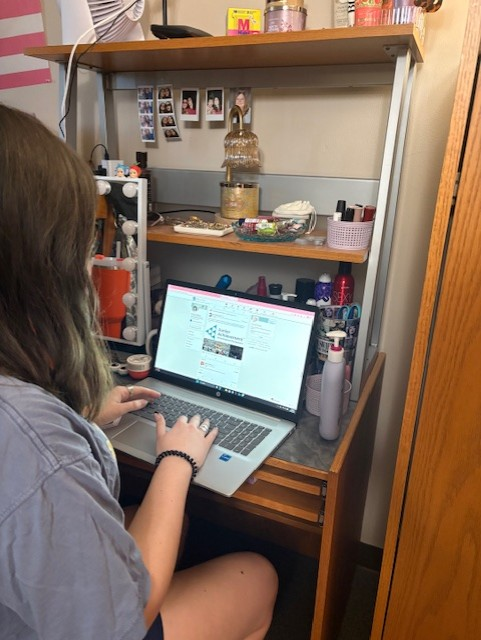
Soon-to-be graduates are voicing concerns about a highly competitive the job market.
Kurtis Kowalski, a senior mass communication with a sports specialization major, said he is weighing all his employment options with an open mind.
“Specifically, for me being a sports com major, like there’s not–sports is very high competition–so there are not many jobs out there and the ones that are, there are a lot of people gunning for them because everyone wants to work in sports,” said Kowalski.
Kowalski, who has been interviewing for multiple and diverse opportunities, said had to turn down an offer in Florida because of the tight economic realities many Americans are facing, along with the distance from his home in Pennsylvania.
“At the end of the day, it was definitely the best decision because I would have been living on a prayer if I took that job,” said Kowalski.
Nadia Peimany, a senior business administration marketing major, is also worried about her chances of securing employment after graduation.
“I’m actually afraid of the current job market. I think it’s like really bad, especially like, no one wants to hire anyone anymore,” said Peimany.
Peimany had a few interviews, but she said it is difficult to find a position opening that aligns with her talents and passion.
Kowalski feels graduates with majors specializing in sports are facing a particularly competitive because of the popularity of sports careers and what he said is a lack of opportunity. He also believes new graduates face a difficult job market in general.
“It’s tough. I mean, with anything nowadays, like even just our country as a whole, we’re in such a unique place and getting, you know, paying back your loans is in a unique place. Getting a job is a unique place,” said Kowalski.
Kowalski added that while universities do prepare students for future careers, the job market is much poorer than it was when he started college.
“That’s why it’s awesome we have the Insalaco Center for Career Development down there with Johnna Evans. She does her best. So does Tiffany. They do great stuff down there,” said Kowalski.
Kowalski said it is very important to have connections within the profession graduates are pursuing, and having a degree doesn’t distinguish one applicant from another anymore.
“Connections are what’s going to land you jobs ultimately, because there are plenty of people out there with bachelor’s degrees now,” said Kowalski.
Artificial intelligence is a new concern students may have to worry about in their future fields of work. Peimany is concerned that chosen career in marketing and graphic design may be threatened by AI.
“Yeah, so 100%. I worry that, especially in my field, marking graphic design, social media photography, I definitely think AI will take over those jobs,” said Peimany.
However, Kowalski is not worried AI will replace his field of work due to human charisma and genuine connection.
“Working with people in general, they’re going to know when things are AI or if they’re just being talked to by a robot and they don’t like that. And I think how I am as a very outgoing person, they’re not going to be able to replicate that,” said Kowalski.
Computer science professor Steven Tedford said that it is not as much about whether AI is causing certain fields to go away but about finding a way to use AI to help workers do their jobs.
“Having the AI be more of a ‘let’s do the basic stuff,’ while being able to tell it what to ask, knowing what’s the right thing to ask, being able to look at it and interpret what it’s telling you and decide if there’s bias going on. Those are skills that are never going to go away,” said Tedford.
Tedford thinks AI is a tool workers can use productively. He compared AI worries to the time graphing calculators first came out, and there was worry students wouldn’t be able to add or subtract. AI is something to adapt to, he said.
“But the more comfortable you are with the modern set of tools, whether it’s AI or whether it’s the next best thing, the more employers are going to say, ‘that’s somebody that I want,’” said Tedford.
Tedford thinks the ability to work alongside AI instead of competing with the tool will set up students to be successful.
Seniors also believe feel the internships and extracurriculars have armed them with the skills they need to enter the work force.
Kowalski believes professors and the university community have helped him onto the path of success.
“So, I feel like the professors we have here did a really good job at preparing us as well as, you know, the community. I feel like the community we have here at Mis is really good,” said Kowalski.
However, internships are what Kowalski feels have prepared him the most.
“Interning in the PR department here at Misericordia was one of the best decisions I’ve ever made. I’ve learned so much working under Sam Jarvis, our director, here for public relations and marketing,” said Kowalski.
Kowalski said his PR internship helped him build connections with peers, gain career advice from staff, and develop needed skills.
Peimany also feels her marketing internship at Misericordia has prepared her for her future through all the photography experience she was exposed to.
Tedford agrees on the importance of internships and extracurriculars in enabling students to apply knowledge and skills.
“Employers don’t care that you have a minor called X, Y, and Z. They care about what skills you show and what you can do,” said Tedford.
Kowalski might stay as a graduate assistant because of the community and chance to be close to home.
“I’ve kind of talked about pursuing graduate assistant employment here, because I really think that would help further my career and still help me to be here at Mis long, because, like I’ve mentioned, I love the community here,” said Kowalski.
Peimany said she is feeling pressure to quickly secure employment but she is confident that, with her skills, she will be successful.
Tedford encourages students to get hands-on experience. He is now pushing for students to do research programs, internships and anything that makes them stand out.
“I would say find a way to be as prepared as you can for what particular job you’re looking for. Do your research, figure out, ‘hey this is exactly what I want,’ but don’t lock yourself into things. Be open to maybe something you hadn’t thought of,” said Tedford.