

Sports are universal, but they are organized and run in different ways, depending on the country. When I moved overseas to Italy, one of my biggest concerns was whether I would be able to still do gymnastics. Fortunately, yes, I was, but the experience was vastly different from what I was experiencing in the United States.
In the U.S, gymnastics is structured through a defined level system, ranging from levels 1-10, as well as an Xcel program (bronze through diamond), which is basically more of a make-your-own-routines system rather than one that requires athletes to follow set routines for every event. Once you get past level 10, you can then advance to elite, which is the “level” of Olympic gymnasts. In Italy, however, gymnastics follows a different classification system, ranging from LA-1 to LE and beyond. And it’s like Xcel, where gymnasts have skill levels they must meet, but they may make up the routines. Because the levels do not directly translate, my coaches then had to evaluate each event – beam, bars, floor, and vault – individually to determine where I best fit within the Italian system. Although I was training Xcel Platinum (level 7) in the U.S, my placement in Italy took a while to determine, eventually landing on LD-3.
Another major difference lies in the competition format. In the U.S., gymnasts compete both as individuals and as part of a team during each competition. All athletes perform all four events, and the top four scores on each event are added together to determine the team’s final score. Uniformity is key: gymnasts wear the same leotards, style their hair the same, and follow strict rules regarding appearance. Jewelry is prohibited, and excessive makeup can result in deductions before a routine even begins. This uniform look is intended to create a cohesive team appearance, especially on the podium.

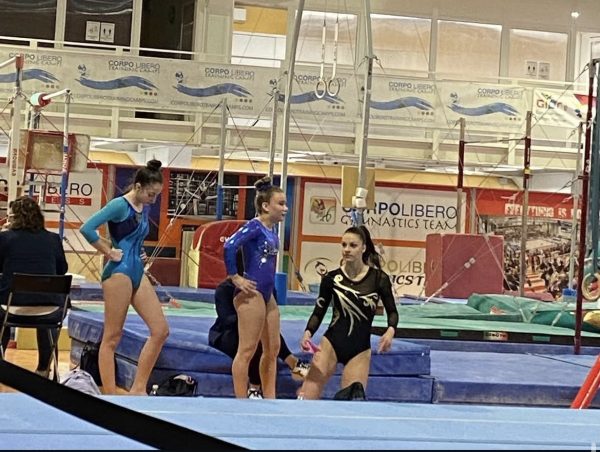
Competitions are structured quite differently in Italy. Athletes often compete only as individuals, even if they train with the same team. For example, I competed individually at the LD-3 level, while some of my teammates competed at the LC-3. Since we were not competing as a unified team, gymnasts had more freedom in their appearance. They could style their hair in whatever way felt most comfortable – I usually had one bun- and rules regarding jewelry and makeup were more relaxed than in the U.S. I was able to have earrings as well as hair clips that I got from the vendors at the competition.
Leotard rules also differed. In Italy, I was allowed to wear any leotard I liked if my gym’s logo was visible somewhere on it. For my individual competitions, I wore a leotard with lace and mesh sleeves and sewed the logo patch onto the hip area. Team competitions were more like those in the U.S., with everyone wearing the same leotards and coordinating hairstyles. However, team competitions were held separately, and I competed at a lower level, LC-3, performing only two events, which then went into the overall team score.
Although the rules, structure, and presentation of gymnastics differed greatly between the countries, the core of the sport remained the same. Competing in both allowed me to see gymnastics from a broader perspective and appreciate how culture influences everything.
.