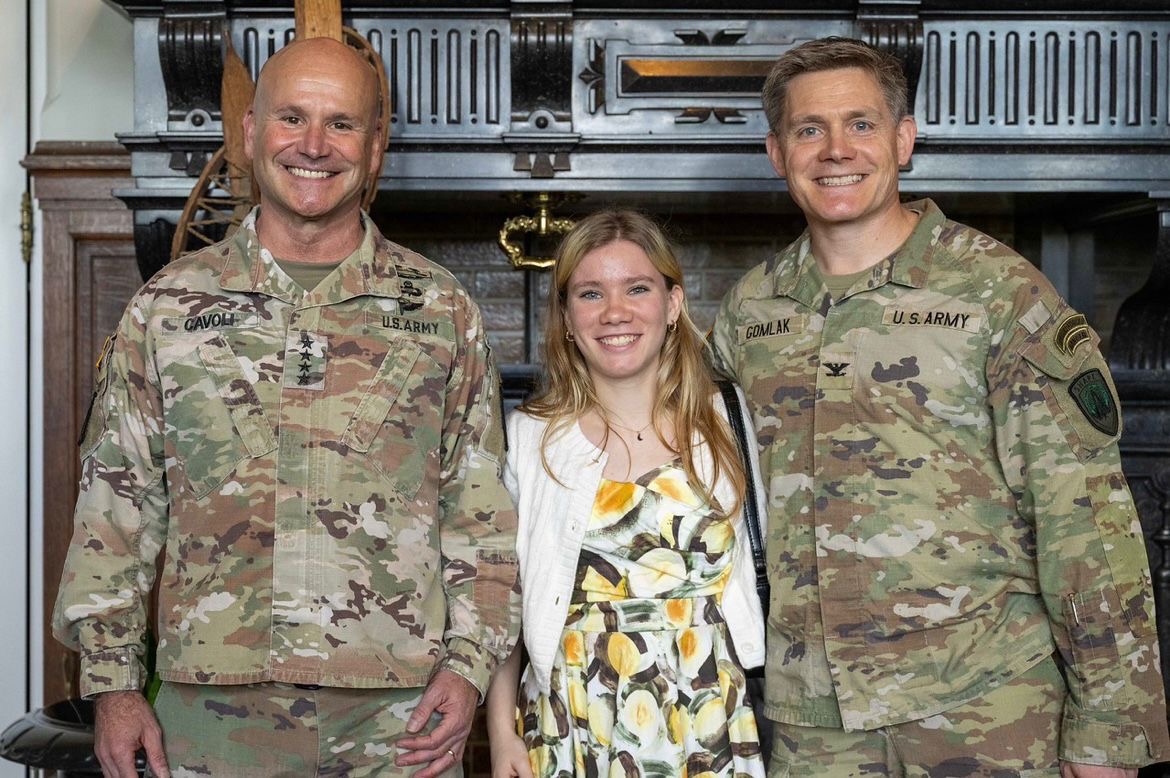

While most American teenagers spend their high school years driving to football games, cheering at pep rallies and attending school dances, my experiences happened thousands of miles away. Unlike the typical American households high school students live in, I spent my high school years learning how to live life in Italy and Belgium, two countries that have changed the way I see the world.
It’s been a little over five years since I last fully immersed myself in American culture. Between the pandemic and living overseas, my sense of “normal” has changed dramatically. What started as only a move to Italy turned into a defining chapter of my life.
I spent my first years of high school in Vicenza, which is in the northern part of Italy, on a U.S. military base called Caserma Ederle. The base, shared by both American and Italian forces, served as its own community where the cultures would blend in day-to-day life. I attended an American school that also enrolled Italian students, giving me the rare opportunity to experience both systems at once, as I learned another language.
Living there shaped me in many ways. I learned how to cook authentic Italian dishes from scratch, picked up the dialect from Northern Italy, and learned the locals’ style. Italians take great pride in their appearance. Showing up to school or the grocery store in pajamas or sweatpants is unheard of and rude, in contrast to the casualness of life in the United States.

The cultural differences do not end there. The imperial system, which is so familiar to Americans, is nonexistent in Europe. After years abroad, I have since only thought in metric units (centimeters, kilometers, grams and degrees Celsius). Because everyone there only uses the metric system, its logic made sense to me. It is entirely based on powers of ten, so it is very easy to understand. Cooking became more precise, with ingredients weighed on food scales and temperature measured in Celsius, where water freezes at zero and boils at 100.
The second part of my high school experience took place in Belgium, at an American school on a North Atlantic Treaty Organization (NATO) base. Only 35 percent of the students there were American. The rest came from countries across Europe. Walking through the hallways, I would hear a mix of English, Spanish, Italian and Romanian, which often blended together in casual conversation. During group projects, the students would seamlessly switch between their native language and English, depending upon who they were talking to.
While many American teenagers spent weekends at school sporting events or local hangouts, my social life looked very different. Many of my friends were from different countries, including Norway and Spain, among others. My friends and I would take the train downtown to explore, go clubbing, or relax at cafes and bars. In Belgium, where the drinking age is 16, most bars actually would serve as common social spaces for teenagers, even those who are not going to drink. They offered a communal way of spending time together, building trust and dependence.
Living abroad during my high school years taught me adaptability, respect, and cultural awareness. I would recommend that everyone take the time to travel abroad and immerse themselves in the culture, so they can experience what I have.
Fun Facts
- In Belgium, there are five ways to deal with trash/recycling: glass bottles, paper, plastic, metal cans/bottles, and normal trash.
- Most universities have three-year master’s degree and not the usual four years for a Bachelor’s as in America, and they cost very little compared to U.S. universities.
- Toilet flush systems are usually located on the wall, with two different flushes: one for #1 and another, more powerful one, for #2. (Sidenote: when I came back from Belgium, it took me way too long to find the flusher, and sometimes I still forget it’s not at the wall and that it’s a lever).